1. Encryption at Source
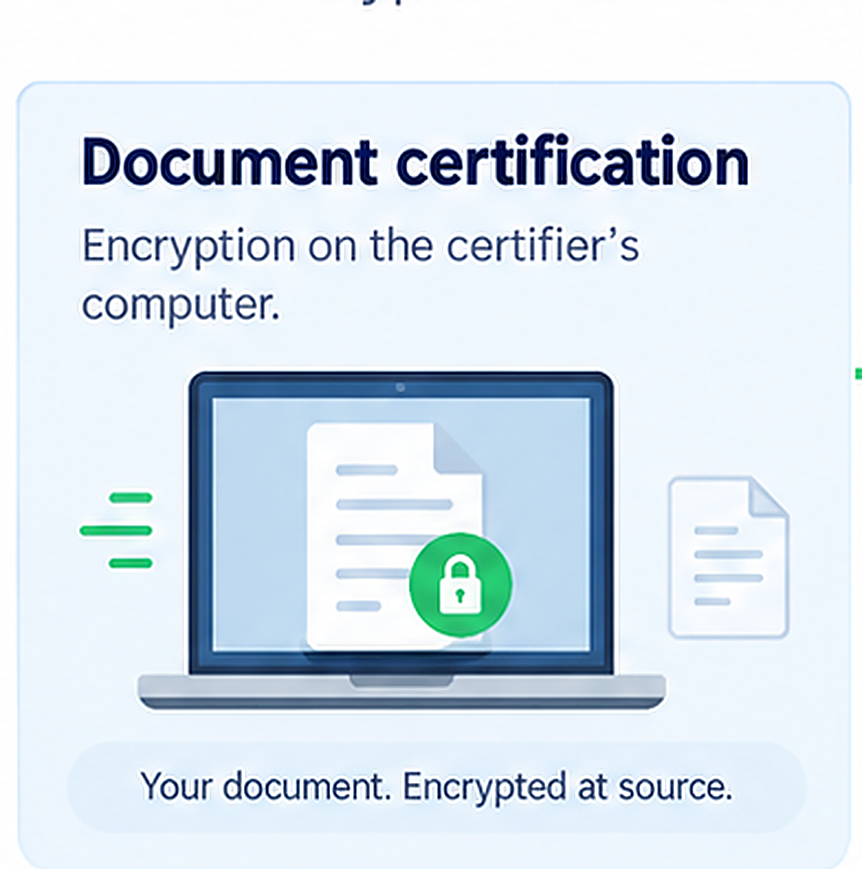
Documents are encrypted on the certifier's computer
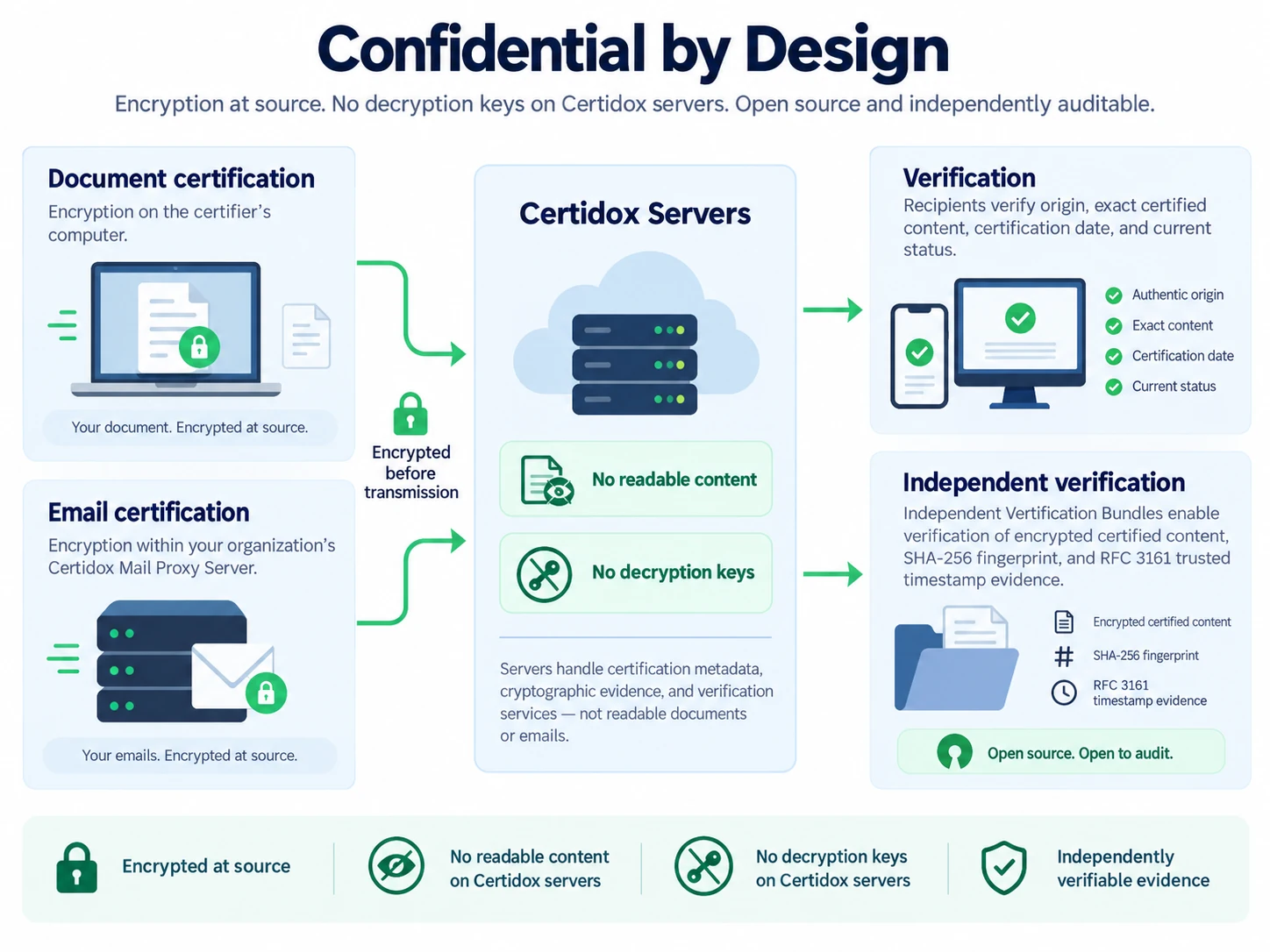
When an organization certifies a document, the encryption process takes place locally, on the computer used for certification.
The document is encrypted before its protected content is transmitted to Certidox infrastructure.
Certidox servers therefore do not need to receive or process the document in readable form.
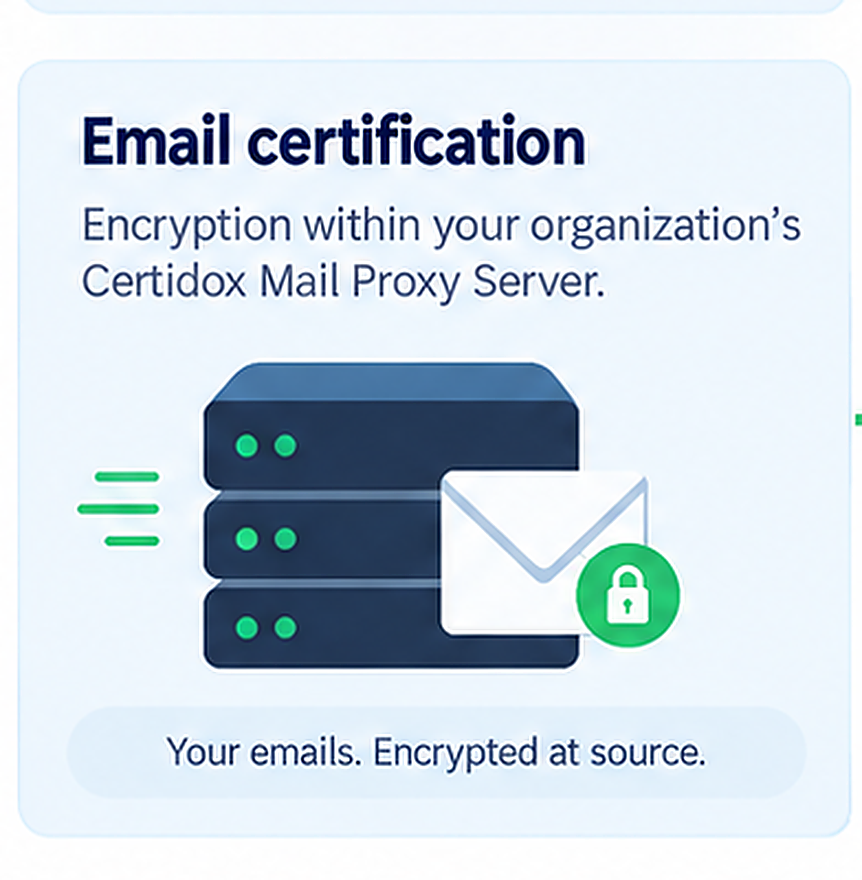
Emails are encrypted within your organization
For automatic email certification, encryption is performed by the Certidox Mail Proxy Server installed within the organization's own environment.
Outgoing email content is encrypted before the relevant certification data is transmitted to Certidox infrastructure.
Certidox supports Microsoft 365 and Gmail/Google Workspace, including business mailboxes using custom domains.
Employees continue using their existing email applications without changing their workflow.
Documents: encrypted on the certifier's computer. Emails: encrypted within your organization.
2. No Readable Content. No Decryption Keys.
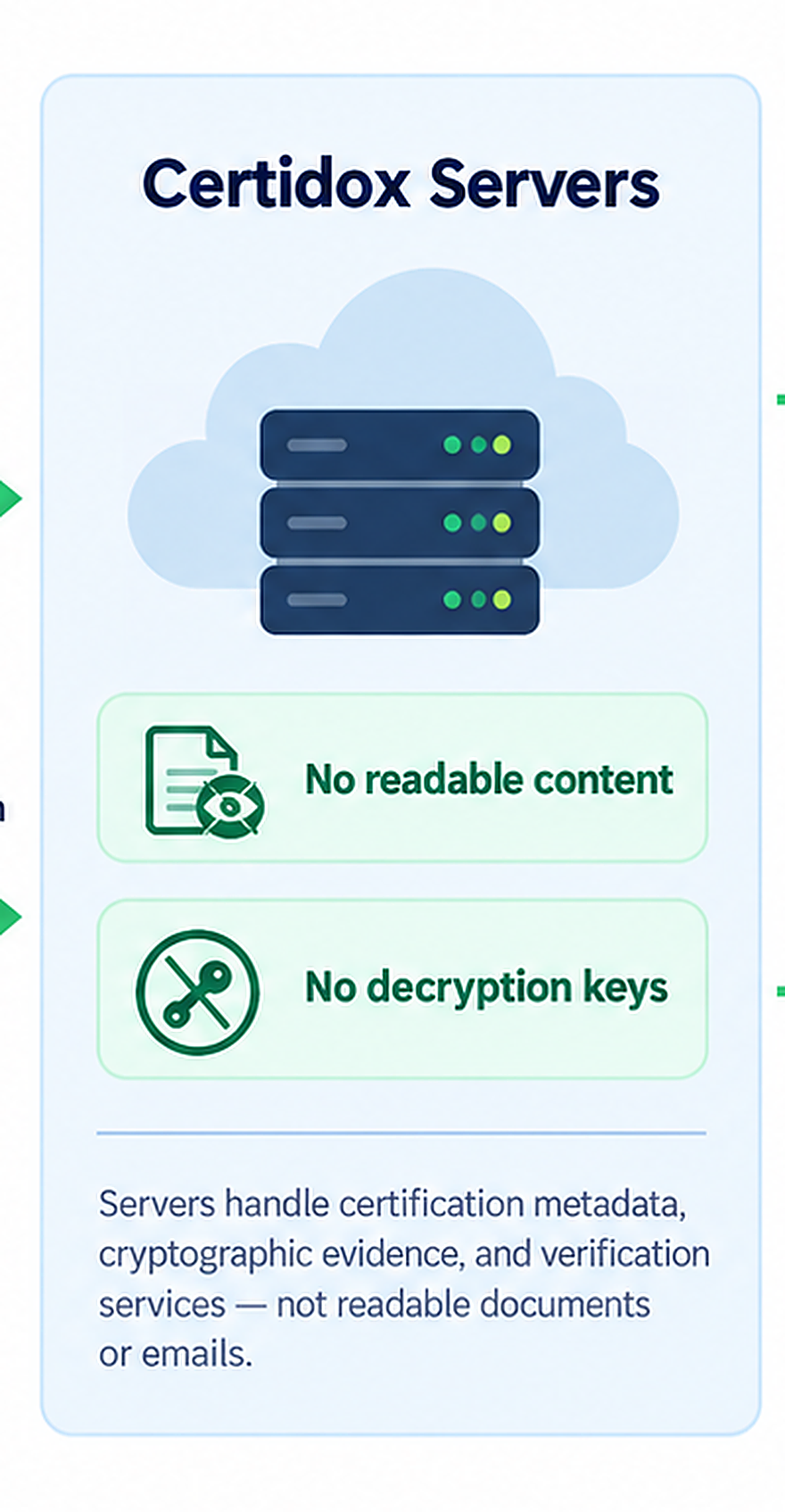
What Certidox servers cannot access
Certidox's architecture separates the certification and verification services from the readable content they protect.
The servers do not store:
- Readable copies of certified documents.
- Readable copies of certified emails.
- Decryption keys for the certified content.
Instead, Certidox uses encrypted information, cryptographic evidence and certification metadata to support verification.
Certidox servers do not hold the keys needed to decrypt your certified content.
This protects confidentiality at the architectural level, rather than relying solely on access restrictions around readable files stored on a server.
3. Confidential Content. Independently Verifiable Evidence.
Verification without server-side decryption
Each Certidox-certified document or email includes a QR code providing access to its certification record.
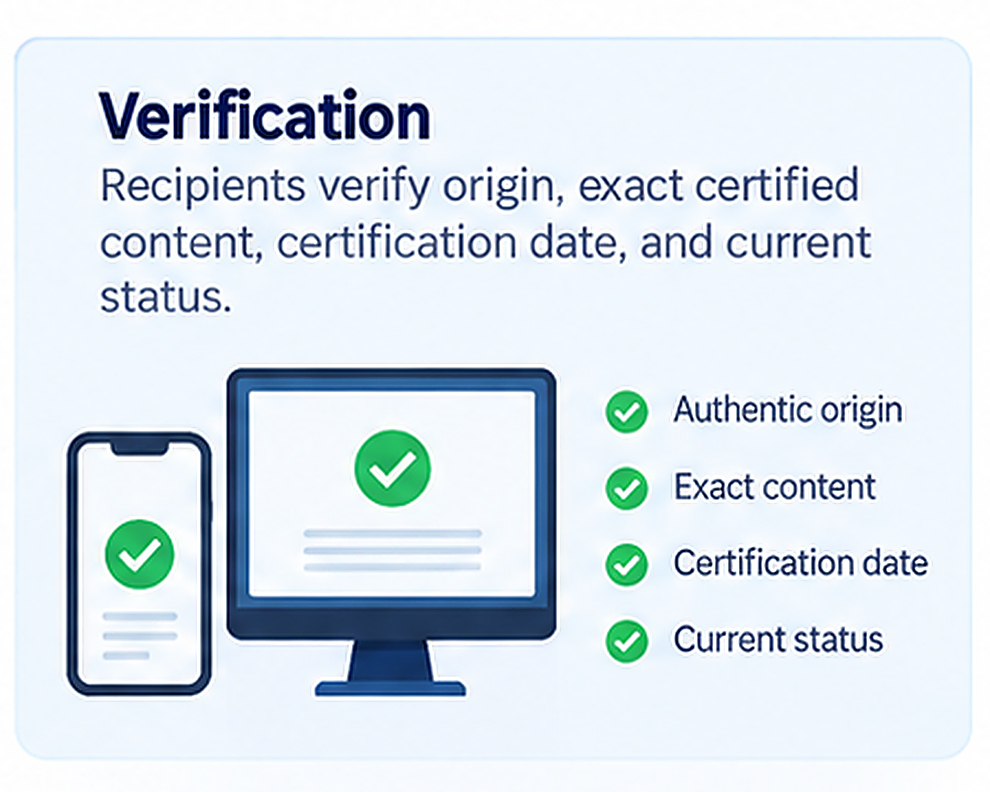
Recipients can verify:
- Origin: The recorded certifying party.
- Exact certified content: The reference information associated with the certification.
- Certification date: When the certification occurred.
- Current status: Whether the certification remains active, revoked or superseded.
The recipient can access the certified reference using the appropriate reading information and compare it with the content received.
This does not require Certidox servers to decrypt and process the underlying document or email in readable form.
The QR code provides access to verification. It does not, by itself, restrict who can read the certified content.
Organizations should therefore manage the distribution of QR codes and associated reading information according to the confidentiality of the underlying documents or emails.
4. Open Source. Open to Audit.
Certidox is not a black box
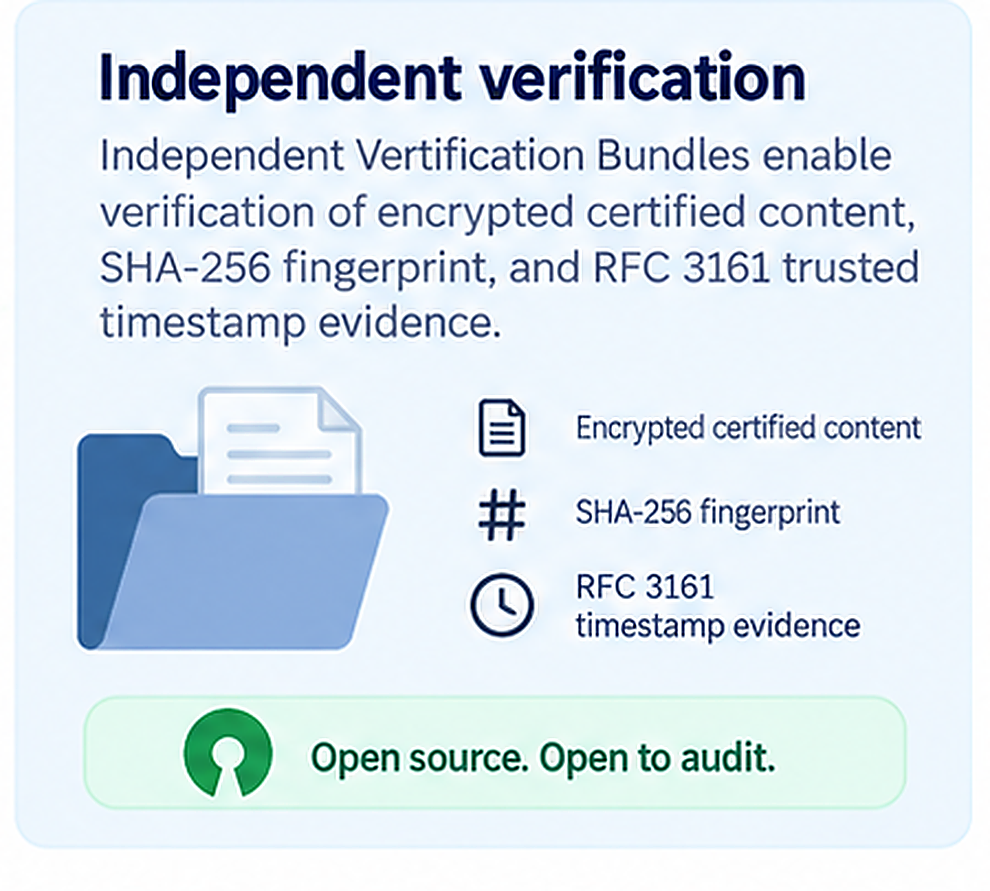
Certidox's source code is open source and can be independently examined and audited.
Organizations, security specialists and independent reviewers can inspect the implementation instead of relying exclusively on claims about how the technology operates.
This transparency makes it possible to examine the relevant cryptographic mechanisms, certification processes and verification components.
Don't just trust our security architecture. Examine the code.
Open-source availability enables independent scrutiny. As with any software, assessing the security of a particular deployment also requires examining its configuration and operation.
5. Independent Verification of Cryptographic Evidence
Verify the evidence without relying on the Certidox interface
Certidox provides downloadable Independent Verification Bundles containing the evidence and tools required to reconstruct certified reference content and verify its historical integrity.
A typical bundle contains:
- document.enc: The encrypted certified payload, protected using AES-256-GCM.
- reading_key.txt: The reading key required to reconstruct the certified content.
- manifest.json: The certification manifest, including the SHA-256 fingerprint and recorded certification information.
- response.tsr: Independent RFC 3161 trusted timestamp evidence.
- decrypt.py: A script for reconstructing the certified payload.
- verify_timestamp.sh: A script supporting cryptographic integrity and timestamp verification.
- readme.txt: Instructions describing the verification procedure.
Using independent cryptographic tools, a verifier can reconstruct the certified content, calculate its SHA-256 fingerprint and validate the associated timestamp evidence using the appropriate trust certificates.
Independent verification does not require access to the Certidox source system or reliance on a Certidox-generated verification display.
A complete verification bundle contains both encrypted content and its reading key. Anyone possessing both can reconstruct the certified reference.
These bundles must therefore be protected and distributed according to the sensitivity of the information they contain.
AI-assisted evidence analysis
Certidox SI Skills can help AI agents examine and interpret Independent Verification Bundles.
AI-assisted analysis helps users understand the evidence but does not replace cryptographic validation.
The certification's current status remains a separate, live value provided by Certidox.
6. Confidentiality Throughout the Document Lifecycle
Certify. Share. Verify. Stay informed.
Certidox supports digital and printed documents, originals and copies.
Organizations can distribute certified documents and emails through their existing communication channels.
Recipients can independently verify the associated certification record before relying on the information.
Authorized organizations can subsequently revoke or supersede a certification without changing its original certified content.
Eligible previous verifiers may receive real-time notifications when the certification status changes.
The certified content stays fixed. Its status can change.
Frequently Asked Questions
Where does Certidox encrypt documents?
Documents are encrypted on the certifier's computer, before their protected content reaches Certidox infrastructure.
Where are certified emails encrypted?
Outgoing emails are encrypted by the Certidox Mail Proxy Server installed within the organization's own environment.
Does Certidox store readable documents or emails?
No. Readable document and email content is neither processed nor stored on Certidox servers.
Does Certidox store decryption keys?
No. Certidox servers do not store the keys required to decrypt certified content.
Can Certidox's source code be independently audited?
Yes. Certidox's open-source code can be examined by organizations and independent security specialists.
Can recipients read confidential information through a Certidox QR code?
A Certidox QR code provides access to certification and verification information.
Anyone who obtains the information required to decrypt certified content may be able to reconstruct and read it.
QR codes and reading keys should therefore be shared according to the confidentiality requirements of the underlying information.
Can certification evidence be independently verified?
Yes. Independent Verification Bundles contain encrypted reference content and the technical evidence needed to verify historical integrity and timestamping using independent tools.
Checking a certification's current status remains a separate live operation.
Protect Confidential Information. Make It Verifiable.
Certidox combines encryption at source, independent verification and open-source transparency.
Your documents and emails remain confidential. Their certified records remain verifiable.