A false announcement or altered filing can mislead investors before the issuer can respond.
Fake press releases and inaccurate EDGAR exhibits can disrupt trading, harm an issuer's reputation and lead to legal or regulatory scrutiny. Errors can also arise after a company has approved the correct original.
Certidox makes the approved release a fixed reference to check before publication, filing or reliance. After distribution, the issuer can revoke the release's certification and choose to alert people who previously verified it.
A forged corporate announcement, such as an acquisition, capital raise or earnings release, circulates under the issuer's name. A familiar logo and credible formatting can make the false information appear authentic.
How Certidox helps
Recipients can check the recorded certifier, current status and exact certified content, then compare it with the received release before relying on the announcement.
THREAT 2
EDGAR Filing Errors
The risk
An issuer approves a correct release, but a figure, passage or exhibit is accidentally omitted or altered during preparation, conversion or filing by a filing agent.
How Certidox helps
The issuer and filing agent can compare the EDGAR-ready and published content with the certified reference to identify discrepancies and investigate their source.
These are illustrative scenarios, not allegations of errors or fraud by a named issuer or filing agent.
Potential Consequences
Market turmoil and investor harmFalse or inaccurate information can influence trading decisions and trigger volatility or investor losses.
Reputational damageA company may face lost confidence, urgent corrections and disruption even when its original approved release was accurate.
Regulatory investigations and litigationDepending on the facts, inaccurate disclosures may lead to regulatory scrutiny, lawsuits and substantial costs.
Criminal prosecution in fraud casesWhere intentional fraud violates applicable criminal laws, the individuals responsible may also face prosecution.
Trust takes years to build and seconds to destroy.
The question is not just “What was published?” It is “Does the published or filed version match the content the issuer certified?”
REAL-WORLD CASE / MARCH–APRIL 2026
Cycurion vs. ACCESS Newswire: A Press Release Disputed in Court
On March 16, 2026, a press release announcing a purported Cycurion acquisition valued at more than $150 million was distributed through ACCESS Newswire. Cycurion stated that it had not authorized the release and that it contained a fabricated Investor Relations contact.
On April 1, 2026, Cycurion filed a complaint against ACCESS Newswire in Wake County, North Carolina, alleging defamation, negligence and unfair or deceptive trade practices and seeking monetary damages. ACCESS Newswire disputes the allegations, considers the claims without merit and says it intends to defend the case.
Why this matters for issuers: Distribution through a recognized newswire is not, by itself, evidence of the issuer's approval. When a company certifies its approved releases with Certidox, news agencies and recipients can independently check the recorded certifier, exact certified content and current certification status before publishing or relying on the announcement.
This case concerns press release distribution, not an EDGAR filing error. The cited disclosures do not establish legal liability or show that Certidox was used in this incident. Verification must be performed by the recipient or distributor; certification alone does not prevent a false release from circulating.
The SEC recognizes filing agents as parties that submit EDGAR filings for issuers. Certain company press releases, such as earnings releases, may appear as Exhibit 99.1 to a Form 8-K. Preparing an EDGAR-compatible document may involve formatting or conversion.
What the issuer can do before and after the handoff
Certify the approved releaseThe company certifies the final document before sending it to the filing agent. Certidox fixes the certified reference and the recorded certification information.
Verify what the filing agent is asked to processThe filing agent checks the recorded certifier, certified reference, certification date and live status before preparing the submission.
Compare the EDGAR-ready exhibitAfter conversion or preparation, the substantive text, figures and disclosures are compared with the certified reference. An HTML or ASCII exhibit should not be expected to share the original PDF’s byte-level hash.
Review the actual SEC-displayed versionOnce the submission is accepted, the issuer or its adviser compares the public EDGAR exhibit with the approved reference and checks the official EDGAR filing record separately.
If the versions differ, Certidox supplies a historically fixed reference for investigating the discrepancy. The issuer and the filing agent can identify the content that was certified, rather than arguing solely from document appearance or memory.
Certidox does not, by itself, prove email delivery, what a filing agent received, EDGAR submission, SEC acceptance or regulatory compliance. Those events require their own records and controls.
Keep Control After Publication With Certidox
Certidox does more than certify a press release. It allows you to retain control over its certification status even after publication.
Unlike a conventional press release, a Certidox-certified release remains under the issuer's control: its certification can be revoked at any time, even if copies are still circulating.
Anyone who subsequently verifies the release will see its updated certification status. The issuer can also choose to send real-time alerts to people who have previously verified it.
Revoke the certification. Alert previous verifiers. A release may continue circulating, but a fresh verification reveals that its certification is no longer valid.
How revocation and alerts work
Revoke the certificationThe issuer revokes the original release's certification. Its QR code remains scannable, but a fresh verification displays REVOKED. The original certified content remains unchanged.
Notify previous verifiersPeople who previously verified the release can receive a real-time status-change alert if the issuer chooses to notify them. They can then check the updated certification status before relying on the release again.
Certify a corrected release when neededIf an erratum is required, the issuer certifies the corrected version with its own Certidox QR code, then distributes it through the usual channels. The original certification record remains available.
Revoking a certification does not delete or recall previously distributed copies. An alert does not guarantee that its recipient has read it. Anyone relying on a release should verify its current certification status.
This section describes the revocation and erratum workflow. The FinanceWire release shown below is a separate certification demonstration, not an example of a revoked release.
Certify Your Press Releases.Certidox Helps News Agencies Publish with Confidence.
When your company certifies its press releases with Certidox, news agencies can independently verify their origin, exact certified content and current status before publishing them.
A news agency or regulatory news distributor receives announcements from many organizations. A polished release or recognizable sender address is not, by itself, sufficient to authenticate the content.
When a received press release includes a Certidox QR code or verification reference, a news agency can design an intake workflow that checks the certification record before publication. Connecting that workflow to a verification service, and any automated matching of the content, requires technical integration and confirmation of the available interface.
Receive the certified press releaseIdentify the Certidox QR code or verification reference supplied with the announcement.
Run the verification checkUse the verification service to examine the recorded certifying party, certification date and current status.
Compare the content before publicationConfirm that the announcement to be published matches the certified reference. Automated content matching would require implementation in the agency’s own workflow.
Escalate any discrepancyIf certification is missing, revoked or inconsistent with the received content, route the announcement for editorial review before publication.
From issuer approval to news distribution, verification can become a control in the process, not an afterthought.
This is an integration scenario, not a claim that any particular agency currently uses a Certidox API or that transformed documents are automatically compared by Certidox.
Certify Your Press Releases.Certidox Helps Trading Systems Act on Verified Information.
By certifying its press releases with Certidox, your company makes them independently verifiable by trading systems configured to check the issuer, certified content and current status before executing trades.
Automated trading systems can process press releases and generate buy or sell orders without waiting for human review. A forged announcement, an altered earnings figure or a revoked release can therefore trigger harmful trading decisions and amplify market volatility.
A trading platform integrating Certidox verification can be configured to require these checks before acting on a release:
Read the verification referenceExtract the Certidox QR code or its associated verification reference from the incoming announcement.
Verify the expected issuerConfirm that the certification record identifies the expected issuer or an authorized certifier. A familiar logo or company name in the release is not sufficient.
Check the current certification statusQuery the live status before any trading decision. A revoked certification must not be treated as active, even when an older copy of the release is still circulating.
Compare the complete contentConfirm that the announcement supplied to the algorithm matches the certified reference. A legitimate QR code copied onto altered content does not certify that altered content.
Wrong issuer, revoked certification, missing verifiable record or content mismatch? Do not trigger an automatic order. Hold the release for review.
With these checks enforced, an integrated trading system can disregard an unverified or revoked release rather than execute a trade on its apparent authenticity.
This is an automated-verification integration scenario. Its operation depends on the available API functions, real-time status access, content-matching logic and the trading platform's own decision rules. A missing certification is not proof of fraud, and no system can reverse trades that have already executed.
Verify Instantly a Real Press Release with Certidox
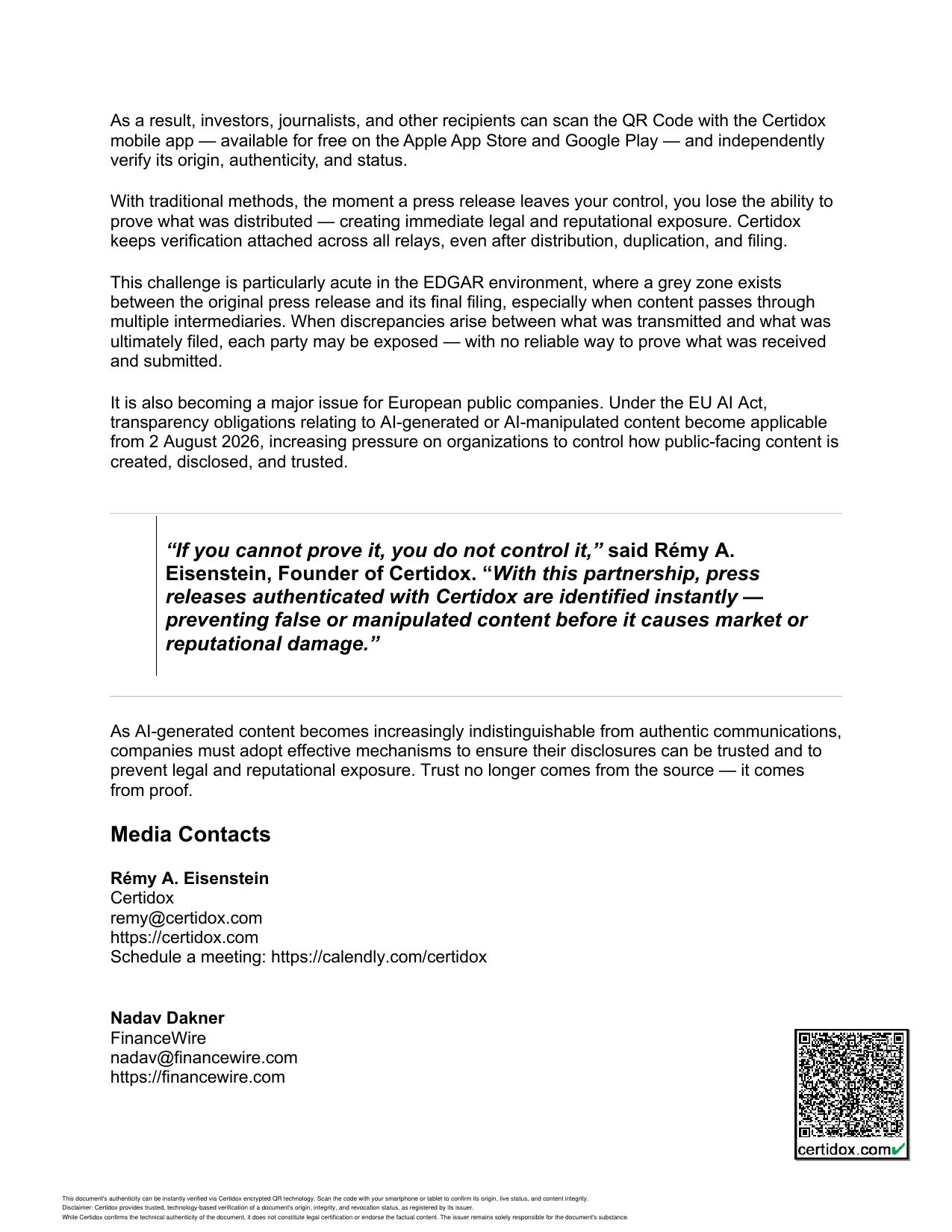
The following example is a real, two-page Certidox-certified FinanceWire press release. Download the original PDF, scan its QR code with the free Certidox app, check the certification record, then compare both pages with the certified reference.
This demonstration's certification identifies CERTIDOX as the certifying organization. It does not claim that FinanceWire separately certified the release. App screenshots are historical; a fresh scan is required to check the current status.
Open the original two-page PDF on another screen or print it. Scan the Certidox QR code on page 2 with the free Certidox app. The two pages shown below are part of the same document.
Tap either page to view it at full resolution. The QR code is on page 2.
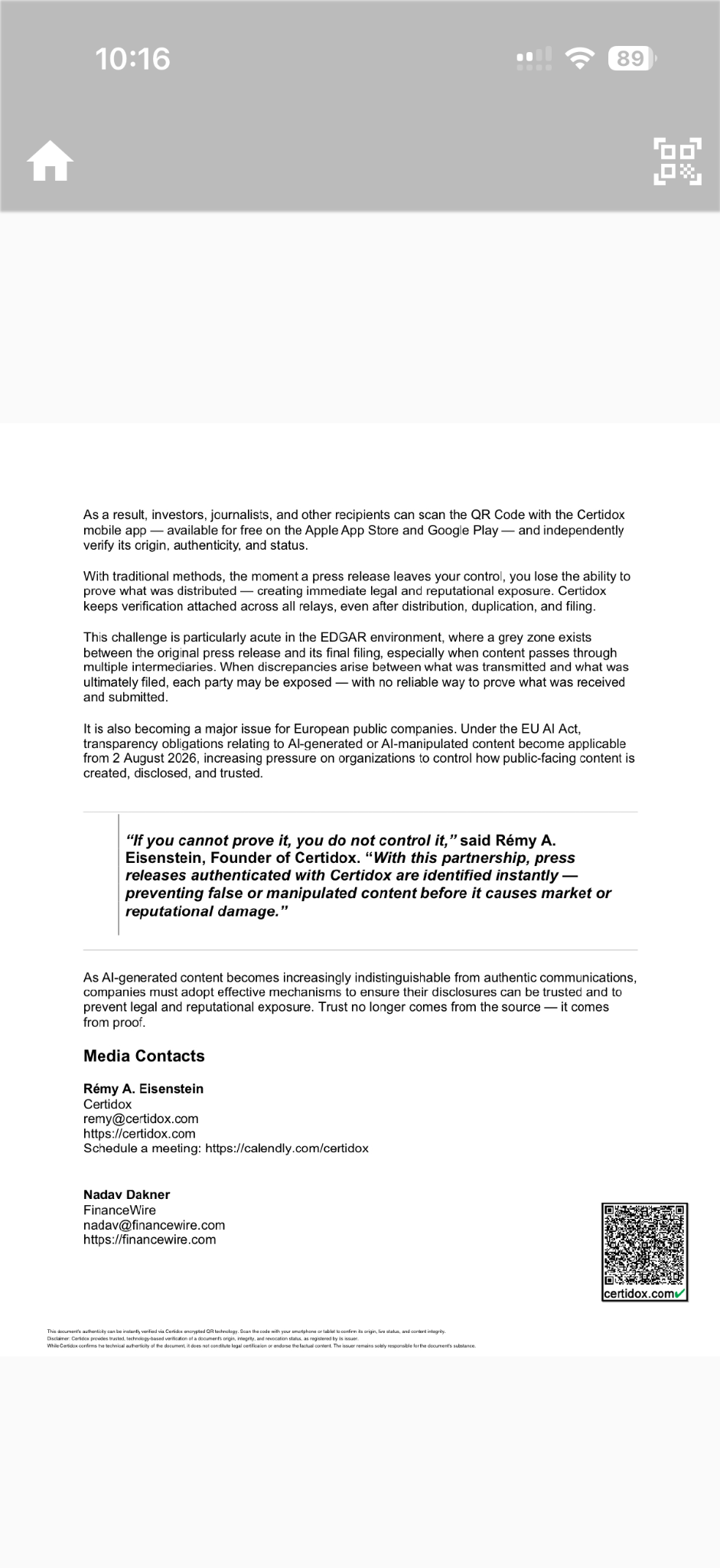
Page 1 of 2. Original press release.Page 2 of 2. Original QR code and media contacts.
STEP 2 OF 3
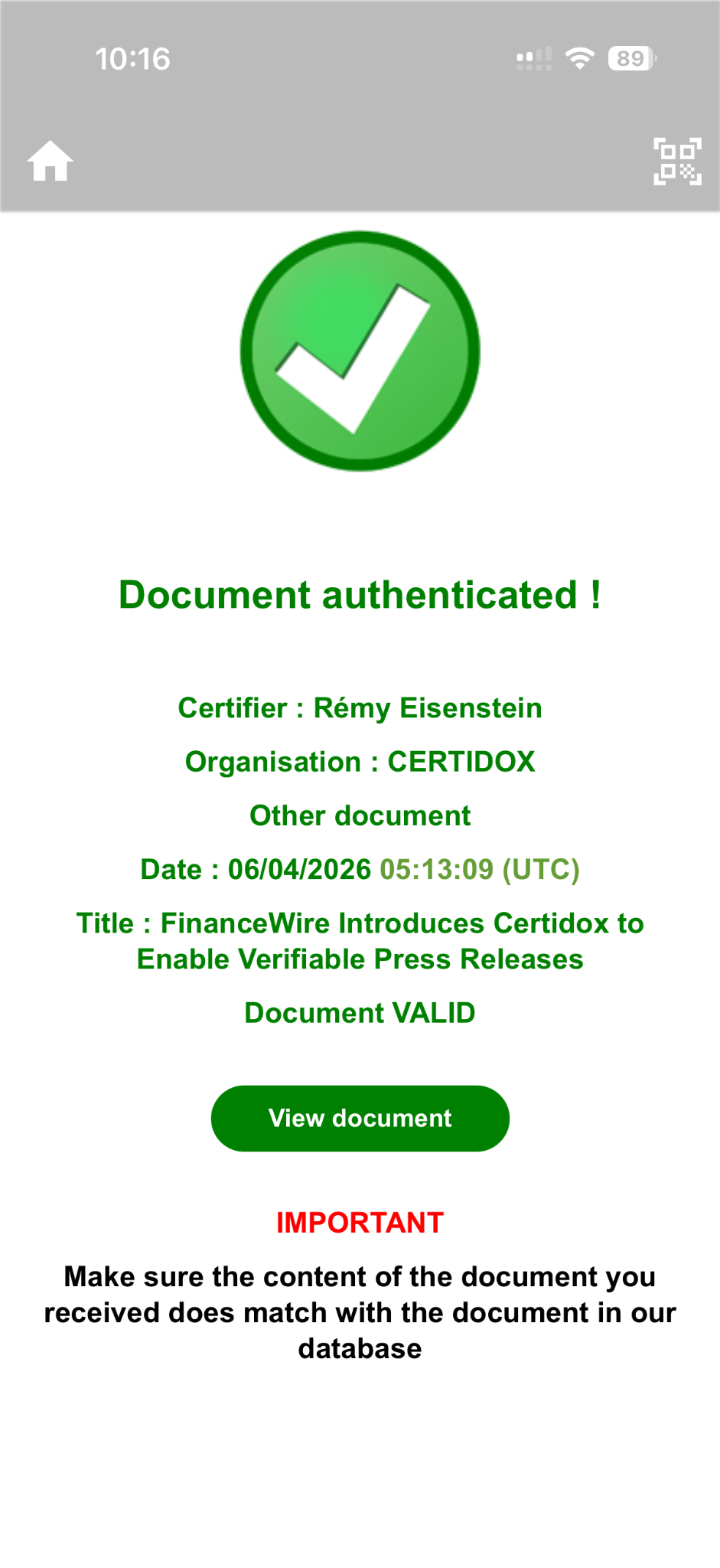
Check the certification record and status
After scanning, check the recorded certifier, certification date, document title and certification status. A legitimate-looking press release is not enough: the certification record must match the expected source.
The green Document VALID screenshot was captured on April 6, 2026. Only a fresh scan can establish the current status.
Actual Certidox app screenshot. Check live status by scanning the PDF again.
STEP 3 OF 3
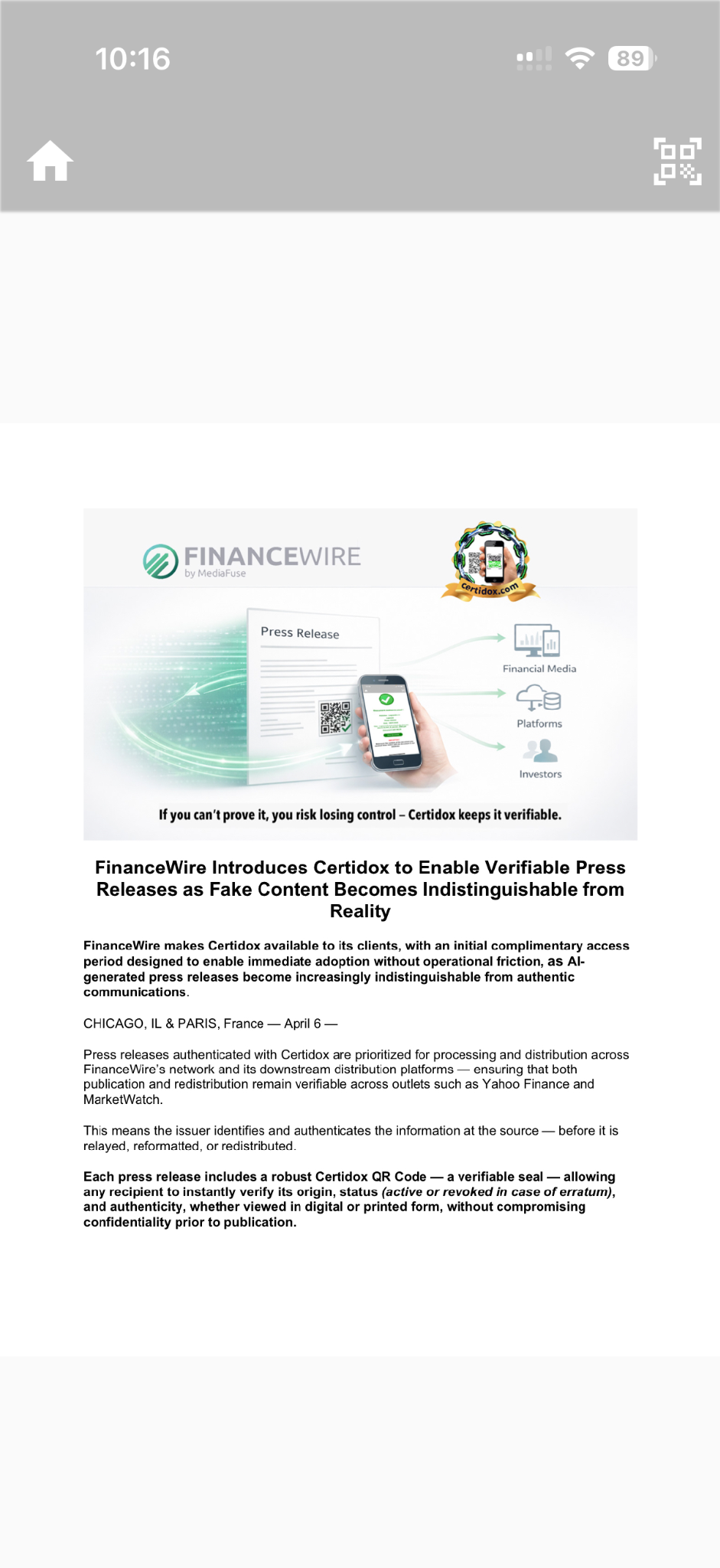
Tap “View document” and compare every page
Tap “View document” to open the certified reference. Compare the complete document, page by page, with the release you received or with the version published or filed on EDGAR. This example has two pages, both shown below.
If any headline, figure, quotation or passage differs, investigate the discrepancy before relying on that version. Always check the current certification status as well.
Original Certidox reference view, page 1 of 2.
Original Certidox reference view, page 2 of 2.
A green result is not enough. Compare the entire certified document with the version you received before relying on it.
The issuer retains a fixed reference of the exact announcement it certified. It can compare that reference with the information subsequently published or filed, identify any discrepancy, and support an investigation or correction. The certified reference does not, on its own, prove who introduced the difference. After publication, the issuer can revoke a certification and choose to notify people who previously verified the release. It can also certify a corrected version without erasing the earlier record.
For filing agents and news distributors
Filing agents can compare the EDGAR-ready content with the issuer-certified reference. News distributors can design intake controls to check certification records, with content comparison and editorial decisions handled separately in their workflow.
For shareholders, analysts and journalists
Investors, journalists and analysts can scan the Certidox QR code, check the recorded certifier, certification date and current status, then use “View document” to consult and compare the exact certified content before relying on the announcement.
For automated trading systems
A platform configured to verify the recorded issuer, match the content and check live certification status can exclude invalid or unverified releases before automatically submitting orders. The platform must enforce those checks in its own workflow.
What Certidox Proves (and Does Not)
Certidox makes the recorded certifier, fixed certified content and historical certification evidence verifiable. The current certification status is checked live. If a dispute arises over the origin, content or certification date of a release, the Independent Verification Bundle enables independent examination of historical cryptographic integrity and timestamp evidence.
Certidox does not establish that every statement in a release is factually correct. It does not replace SEC filing obligations, news agencies’ editorial responsibilities or the issuer’s review and approval procedures.
For EDGAR documents, a formatting conversion may change file bytes. Matching the exact original PDF hash to the SEC HTML exhibit is therefore not the relevant test: compare the substantive published content with the certified reference.
Frequently Asked Questions
What can go wrong when a fake press release or inaccurate EDGAR filing circulates?
Depending on the circumstances, it can mislead investors, disrupt markets, harm the issuer’s reputation and expose companies or individuals to regulatory investigations, litigation or other legal consequences. Intentional fraud can also lead to criminal prosecution.
Can a legitimate press release still contain an EDGAR filing error?
Yes. An error may arise in preparation, conversion or submission even when the original approved release was correct. Comparing the EDGAR version with the certified reference can reveal a discrepancy.
Does Certidox prove what the filing agent received or what the SEC accepted?
No. Certidox proves its recorded certification information and supports checking the certified content. Receipt, submission and SEC acceptance must be established from separate records.
Could a news agency integrate verification into its intake workflow?
An agency can design a verification step within its intake workflow. The available integration method must be confirmed with Certidox; exact-content comparison and editorial actions require separate implementation.
Can investors verify a printed or forwarded announcement?
Yes, when the Certidox QR code or verification reference remains available. They can access the certified reference and compare the content before relying on it.
What happens when an issuer publishes an erratum?
The issuer can revoke the original certification and certify a corrected release with a new QR code. The original QR code remains readable and a fresh verification shows the revoked status. People who previously verified the release can receive a real-time status-change alert if the issuer chooses to notify them. Revocation does not erase or recall the distributed release.
Can automated trading systems screen out fake or revoked press releases?
A trading system configured to require issuer verification, live valid status and a match with the complete certified content can hold or reject releases that fail those checks before submitting orders. This requires an operational verification interface, content comparison and explicit trading-platform rules. A missing certification is not, by itself, proof that a release is fraudulent.
Make Corporate Disclosures Verifiable
Give your investor relations team, filing agents, press agencies and shareholders a common certified reference to check before publication, filing or reliance. After distribution, revoke a certification and choose to alert people who previously verified the release.
Certify. Distribute. Verify. Compare.
See how Certidox helps verify corporate documents and emails, including digital and printed versions, originals and copies. Confidential by design.