WHY CERTIDOX

Your name can be used against you.

Have you also thought about protecting your reputation? Fraudsters can impersonate you through forged documents and emails, putting your revenue and your customers' trust at risk.

See Certidox in action

1st Prize, AI Pitch Competition, New York 2026. Organized by the Manhattan Chamber of Commerce, Futran Solutions and AWS.

Protect your reputation

Help recipients identify fraudulent requests made in your name.

Protect your revenue

Help customers verify payment instructions before transferring funds.

Avoid costly disputes

Keep independently verifiable evidence of what was certified and when.

THE THREAT

Three fraud scenarios. Real consequences for your business.

01REPUTATION AT RISK

“Please resend your contracts and invoices.”

  • As an attorney or CPA, you handle confidential client information.
  • A fraudster impersonates you and asks your clients to resend contracts, or other confidential information.
  • Your clients recognize your name and trust the request.
  • Your systems may never have been compromised, but your clients' confidential information has been disclosed in your name.
What happens to your reputation and their trust in you?
02REVENUE LOSS

“We have changed banks.
Please use our new account for your payments.”

  • A fraudster contacts your customers, impersonating your company, and instructs them to redirect future payments.
  • Your customers believe they are following your instructions.
  • They transfer the money.

You never received the payment.
Yet your business must deal with the consequences.

03COSTLY DISPUTES

“This is the agreement you approved.”

  • A contract originally contains options “A” and “B”.
  • A disputed version subsequently includes options “C” and “D”, adding substantial financial obligations.
  • Your word against theirs: a dispute follows, involving lawyers, forensic experts, mounting costs and uncertainty.

THE CERTIDOX ANSWER

Give your recipients a way to verify your documents and emails before relying on them.

With Certidox, recipients can instantly check who certified a document or email, what its exact certified content is, when it was certified and whether it is still active, before relying on it.

In this fictional real-estate closing, a title company certifies payment instructions. A substituted message later shows a different bank account. The recipient can check before transferring funds.

STEP 01 / CERTIFY

Certification can be manual or automatic.

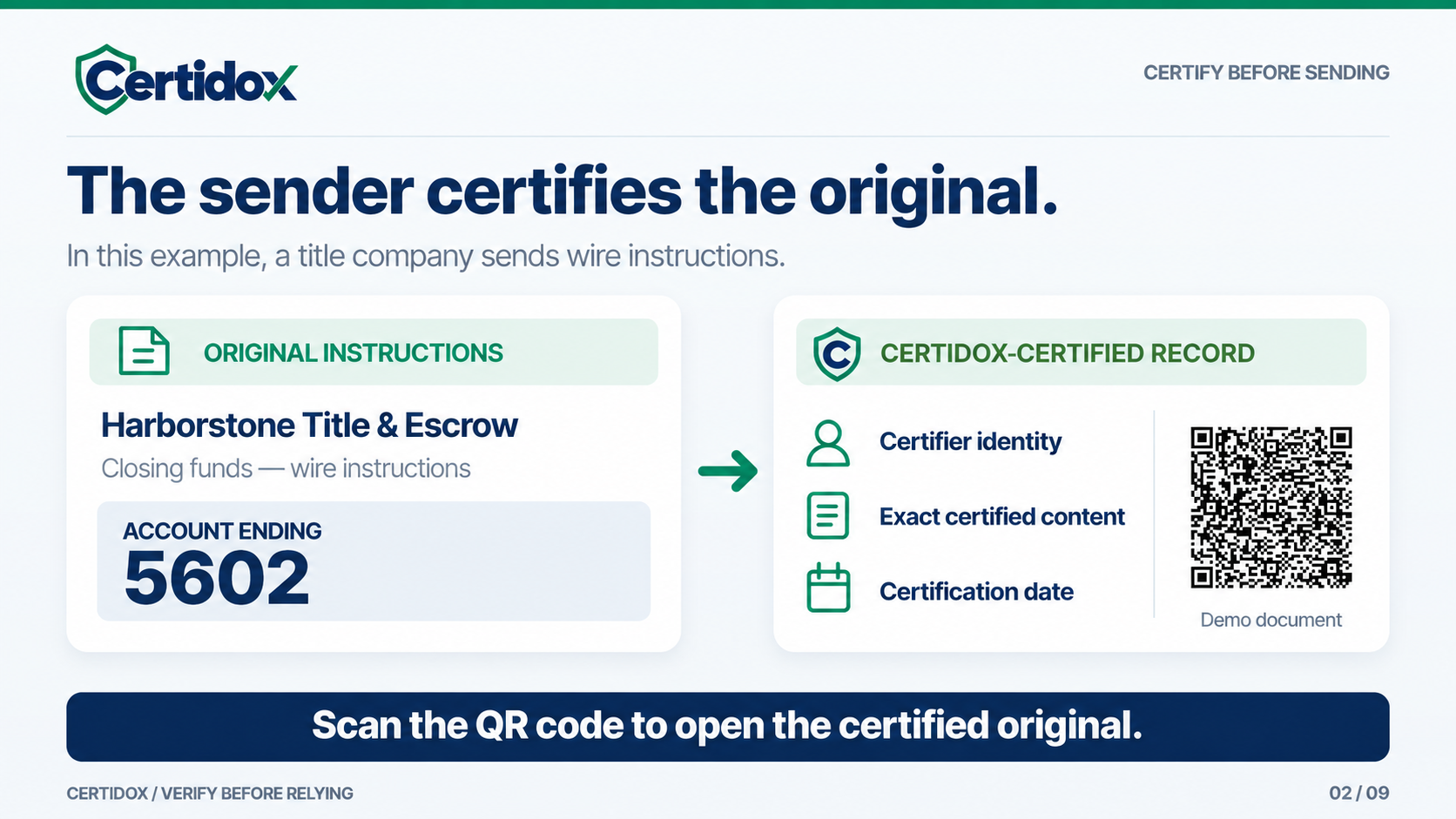
In this example, the original payment instructions show a receiving account ending in 5602. The QR code gives recipients access to that exact certified record.

One QR. A reference to the certified content.

Real demonstration screenshot: original account 5602 alongside a Certidox certification record and scannable QR code.
Original certified payment instructions · Enlarge ↗
STEP 02 / VERIFY

The recipient scans and checks.

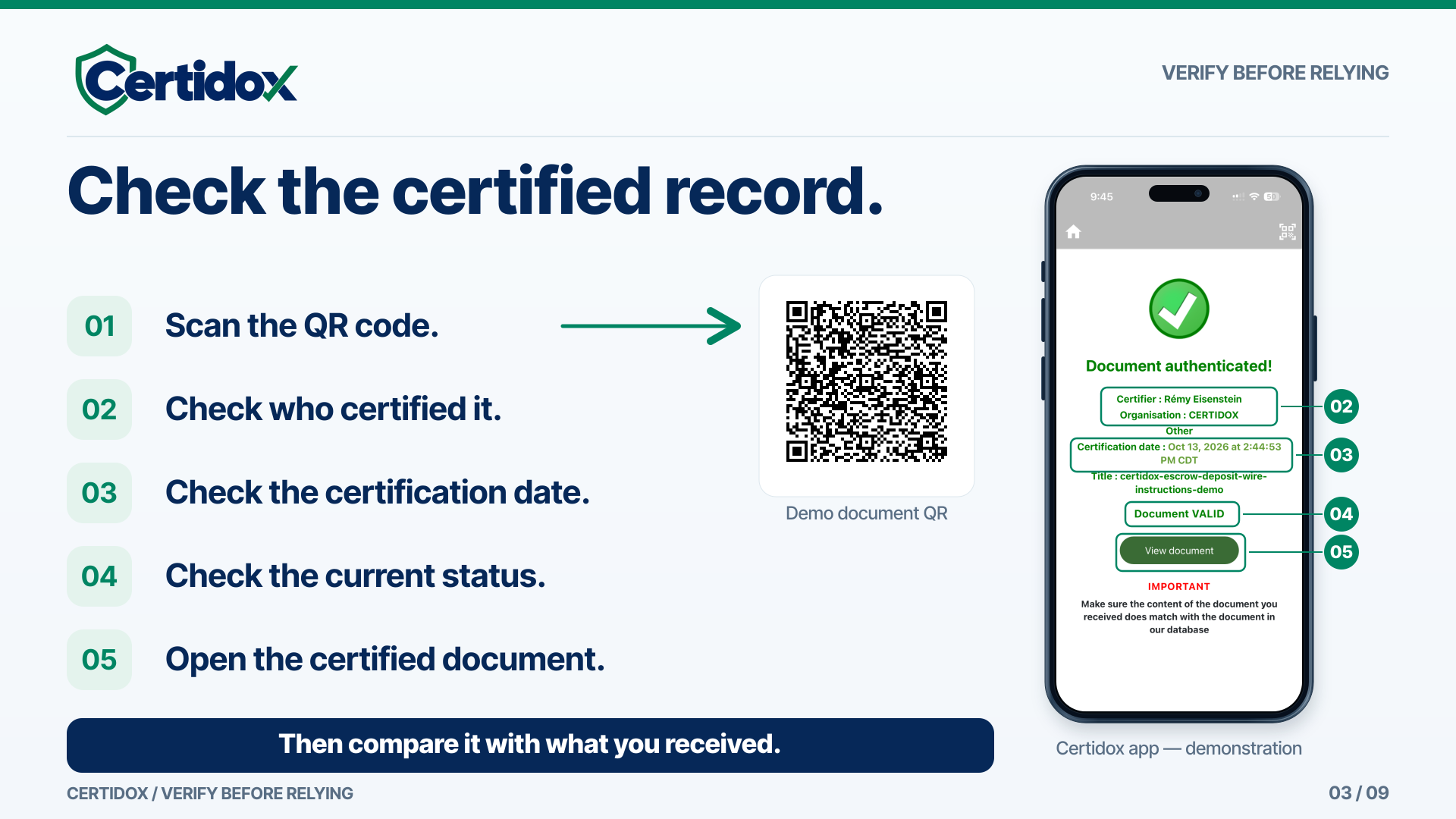
The Certidox app displays the certifier's identity, certification date and current status. But a green check does not replace comparing the contents. The recipient can then tap “View document” to examine the actual certified content.

Certidox app verification screen beside a QR code; verifies issuer, time and status, with a View document button.
Actual Certidox app screen · Enlarge ↗
STEP 03 / COMPARE

The information doesn't match.

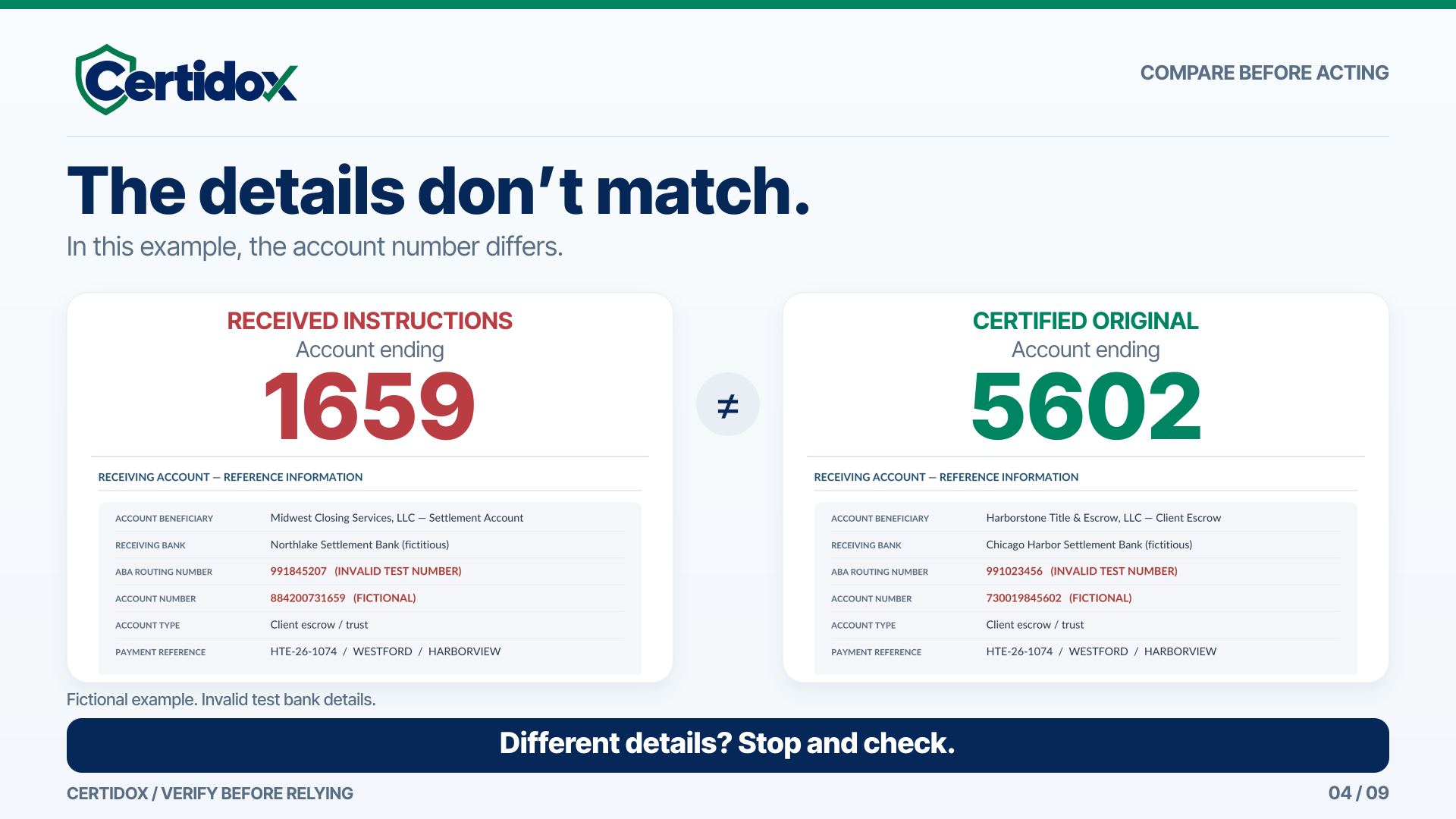
In this case, the message received asks for payment to an account ending in 1659. The certified record says 5602.

Different details? Stop and check, then decide to act or not.

Side-by-side comparison: falsified payment instructions account ending 1659, certified original account ending 5602.
Fictional demonstration with invalid test bank details · Enlarge ↗

Stop taking unnecessary risks. Try Certidox and put it to work.

Let's discuss how Certidox could help protect the documents and emails issued in your name.

Contact us

A MAJOR DIFFERENCE

Keep control after sending.

A document or email has left your system. It has been forwarded, downloaded or printed. With Certidox, you can still change its certification status.

Mark a certification as corrected or revoked. Anyone checking it sees the current status, and you can alert previous verifiers that its status has changed.

Discover real-time status alerts

CERTIFICATION STATUS

Active At issue
↻ Corrected
× Revoked
Alert previous verifiersEven after the document has been shared or printed.

Key advantages

Digital and printed

Certidox works with certified documents whether they are digital or printed, originals or copies.

The same secure QR-based verification works for a printed copy as for a digital file.

Discover how Certidox works

Confidential by design

Your documents and emails are encrypted before reaching Certidox servers.

No readable certified content or decryption keys are stored on Certidox servers.

Client-side encryption protects the confidentiality of certified content.

See how confidentiality is protected

Evidence that can be examined independently

Certidox provides a cryptographic evidence bundle containing hashes, signatures, public keys and a timestamp.

With the certified content and this bundle, the parties can independently check whether the content matches the certification and when it was certified, including in a dispute.

Explore independent verification

A USEFUL TOOL BEYOND CERTIFICATION

Not a Certidox QR code? Check it anyway.

QR codes are everywhere, from everyday notices to payment requests. Some can lead to phishing or fraudulent websites. The Certidox app, available for free on the Apple App Store and Google Play, can also inspect QR codes it did not issue, show the destination and flag potential risks before you open the link.

Link analysis checks the destination. It does not certify the authenticity of third-party documents or guarantee that a website is safe.

Explore non-Certidox QR code analysis

It is time to protect your name and reputation.

Make your documents and emails instantly verifiable with Certidox.